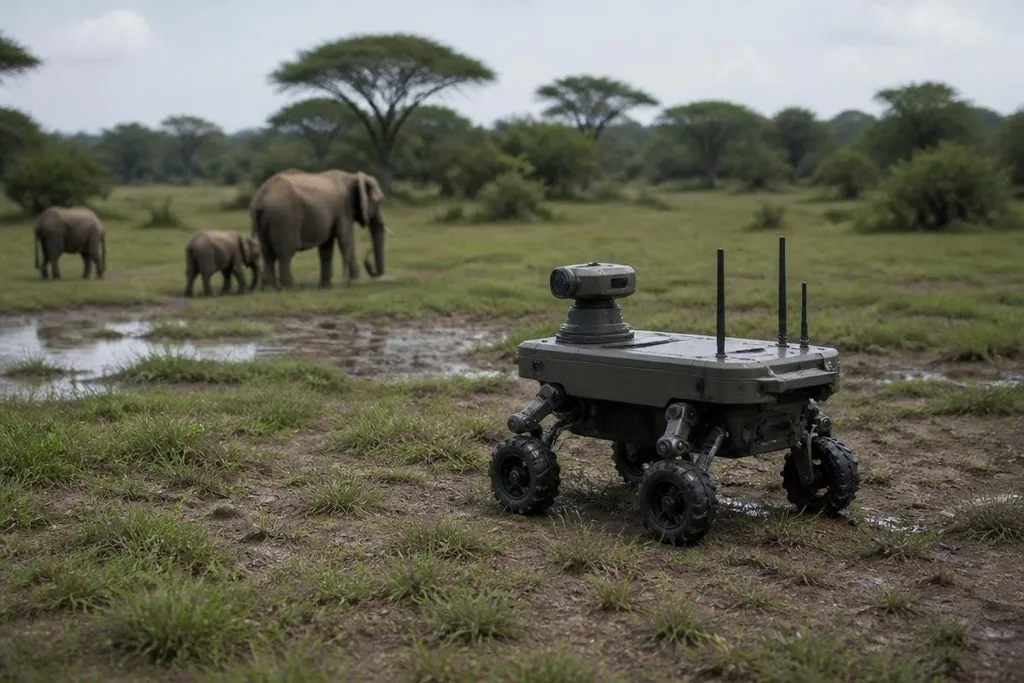
A wildlife robot can look capable in a short clip and still fail after rain, mud, noise, or contact with an animal. The useful race is not to build the most dramatic machine; it is to prove that a robot can collect good data without disturbing the species it studies.
Quick read
- Field time matters more than a polished demonstration
- Animal safety must sit beside battery life and sensor range
- Shared test rules would make claims easier to compare
Field proof and machine design
In a real habitat, the robot must move and record useful information. Those jobs pull the design in different directions: movement can create noise, lights can change animal behavior, and a large body can block paths or damage ground cover.
The robot may use cameras, microphones, thermal sensors, or other tools to record animals and their surroundings. Each sensor creates a trade-off. A camera needs a clear view, while a microphone needs low motor and drivetrain noise. A thermal sensor can detect heat, but its reading still needs context from the place and time of the observation.
That makes the body design part of the research method. Wheel size, leg motion, motor noise, outer materials, and the way the robot turns can affect the data before anyone studies a single image or sound file.
A demonstration can show that a robot moved over one surface or completed one task. It does not, by itself, show how the machine behaves after hours outside, near animals, or when a sensor view becomes blocked.
Useful reporting should state the test conditions. Readers need the surface, weather, distance from animals, operating time, speed, noise level, sensor type, and number of failed attempts. They also need to know if a person controlled the robot or if its software handled the route.
That distinction matters because teleoperation, where a person sends movement commands, can hide limits in autonomous navigation. A robot may work well with a trained operator nearby and need a different design for unsupervised field work.
A wildlife robot faces changing conditions: an animal can alter the task without warning. Reports from Robot24 can place the robot’s task, habitat, operator, and test result beside each claim, helping you tell supervised work from autonomous field use.
The animal comes before the machine
For animal studies, the robot should collect information while changing animal behavior as little as possible. That calls for tests that measure more than movement and battery life.
Researchers and builders should record how animals react to the robot, how close it operates, how often it stops, and what happens when an animal approaches.
A safe system also needs a clear stop method, a low-speed mode, and a plan for recovery if communication fails. If animals avoid the machine, follow it, or change their normal activity, the collected data may describe the robot’s effect rather than the habitat.
What a useful benchmark would contain
A shared test format would make projects easier to compare. It would also give buyers, conservation teams, and research groups a way to separate a working field tool from a promising prototype.
A useful benchmark should record:
- Movement: surface type, slope, speed, turning space, and recovery after a stop
- Sensing: sensor model, useful range, weather limits, and missed observations
- Power: battery size, operating time, charging method, and time lost to maintenance
- Animal contact: distance, observed reactions, emergency stop behavior, and recovery plan
- Control: autonomous actions, operator input, communication range, and signal loss
- Evidence: uncut test footage, raw files, test dates, and the number of repeated runs
The list is practical because each item changes the value of the data. A robot that runs for six hours but needs frequent operator commands has a different use from one that runs for two hours without help.
A buying and testing checklist
Before funding or adopting a wildlife robot, a field team should:
- Ask for test records from the habitat where the robot will work.
- Set a maximum noise level and operating distance before trials begin.
- Define what counts as a missed observation or failed route.
- Check how the robot stops after a lost signal or low battery.
- Keep raw sensor files with time and location data.
- Repeat the trial across more than one weather condition.
I'd reject any wildlife robot whose main proof is a polished clip with no test conditions. The next useful milestone is a shared field record that shows how the machine moves, what it records, and how animals respond when nobody edits the difficult parts out.